Recently, the Extended Reality (XR) Human-Computer Interaction team of Guangxi University has achieved three innovative research breakthroughs in the field of XR operating system graphical user interfaces. The studies, titled "SummonBrush: Enhancing Touch Interaction on Large XR User Interfaces by Augmenting Users' Hands with Virtual Brushes," "BoundaryScreen: Summoning the Home Screen in VR via Walking Outward," and "AmplitudeArrow: On-the-Go AR Menu Selection Using Consecutive Simple Head Gestures and Amplitude Visualization," have been successively published in IEEE Transactions on Visualization and Computer Graphics. All three papers list Associate Professor Tian Yang from the School of Computer , Electronics and Information as both first author and corresponding author, with GXU as the primary research affiliation.
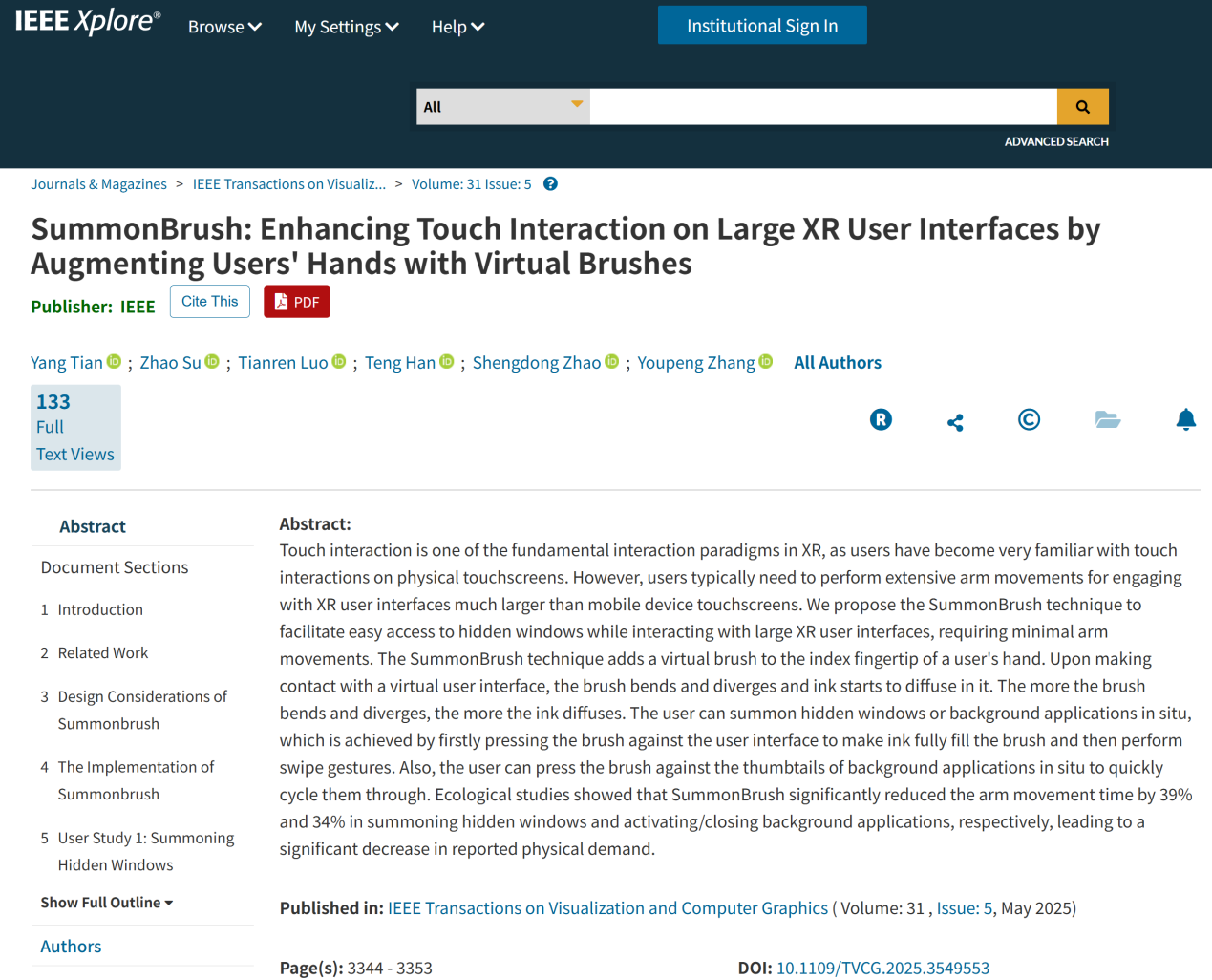
The first research achievement focuses on alleviating user’s upper limb fatigue during interaction with XR operating system interfaces. As touch interaction—a fundamental paradigm in XR environments—builds upon users' familiarity with physical touchscreens, XR OS interfaces significantly expand in scale, requiring extensive arm movements for operation. To address this, the team developed SummonBrush technology, enabling users to effortlessly summon hidden windows while drastically reducing arm movement when interacting with large-scale XR OS interfaces. This technique adds a virtual brush to the user's index fingertip. Upon contacting the virtual interface, the brush bends and spreads outward like a physical brush, while virtual ink diffuses within it. Greater brush change correlates with increased ink diffusion. By pressing the virtual brush against the interface until ink fully fills the brush and executing a swipe gesture, users can summon hidden windows or background applications anywhere on the interface. Additionally, pressing the brush against application thumbnails enables rapid app switching. Experimental results demonstrate 39% and 34% reductions in arm movement time when summoning hidden windows and activating/closing background applications respectively, significantly alleviating upper limb fatigue.
The second research achievement aims to assist users with upper limb impairments in activating the XR OS home screen through walking. In XR space, the safety boundary wall—a virtual barrier appearing only when users approach physical space limits—enables movement and interaction without safety concerns. However, existing implementations overlook its potential for displaying interactive content. Addressing this gap, the team developed BoundaryScreen technology based on an "outward-walking" metaphor to transform the safety boundary into an interactive surface. Specifically, the system embeds the XR OS home screen directly on the safety boundary wall, allowing users to activate it simply by walking outward until the wall becomes visible.
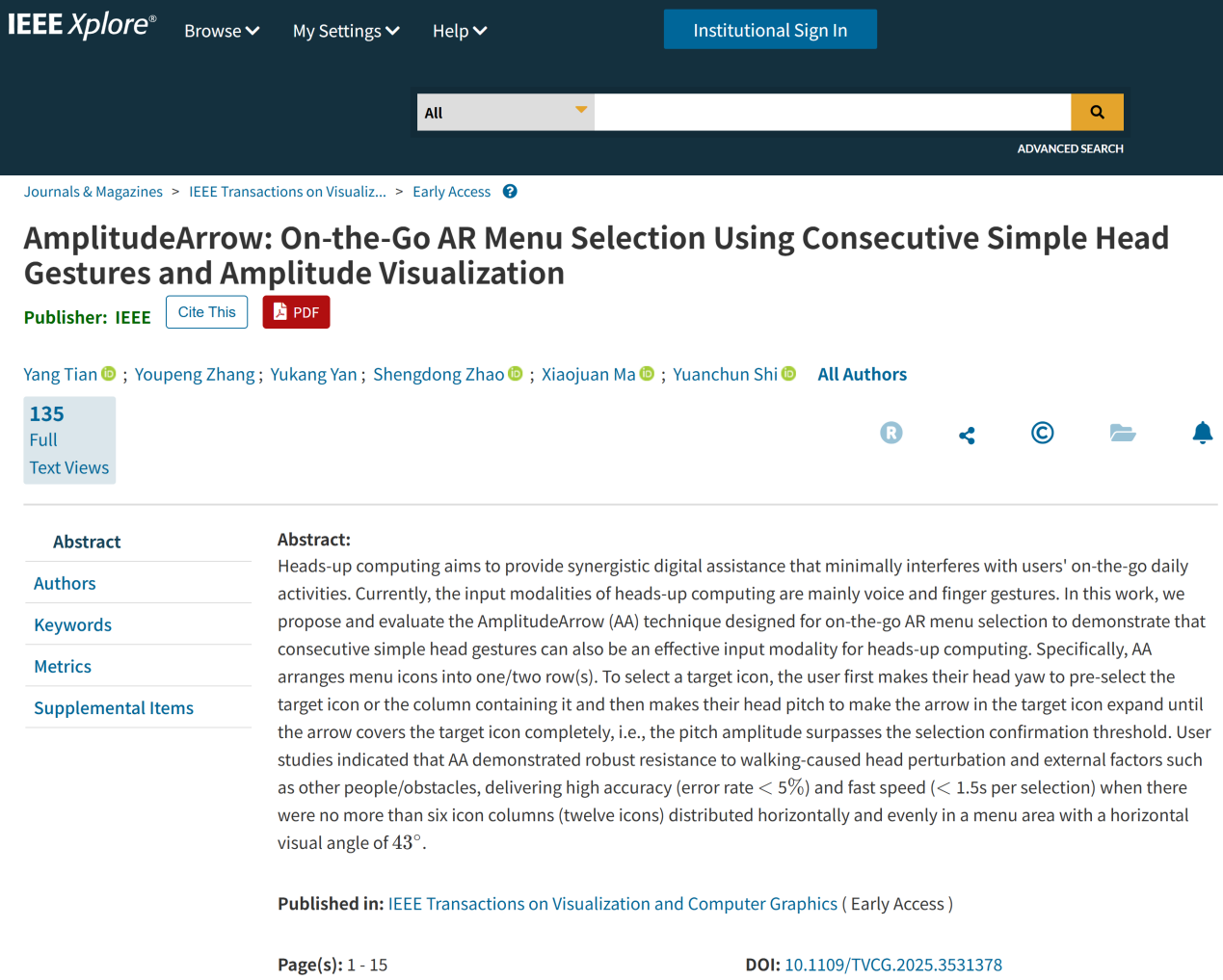
The third research achievement targets enabling users with upper limb impairments to efficiently interact with XR OS interfaces using only simple head rotation gestures. The team proposed and evaluated AmplitudeArrow—an interaction technique designed for use during locomotion that relies exclusively on sequential simple head rotations. By applying dimensionality reduction to the 2D head pointing task, the technique dedicates one axis of head rotation to target selection and the orthogonal axis to selection confirmation, effectively counteracting head oscillations during walking. User studies demonstrated that with horizontally arranged interfaces (≤6 columns, 12 total targets) within a 43-degree horizontal field of view, AmplitudeArrow successfully mitigated head sway induced by walking and external factors (e.g., obstacles or other people), achieving a selection error rate below 5% and rapid selection times under 1.5 seconds per operation.
It is reported that XR glasses have entered the stage of practical application following significant reductions in weight and production costs. These research outcomes provide viable and practical solutions for designing operating system interfaces on still-maturing XR platforms.

 Address: No.100,East Daxue Road,Xixiangtang District,Nanning, Guangxi,China
 Postal Code: 530004
 Tel: 86-771-3238863
 Email: gjc@gxu.edu.cn