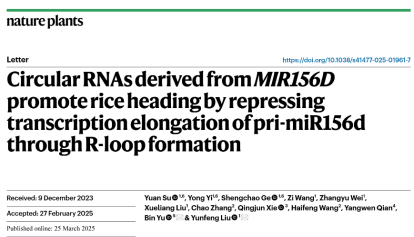
Recently, Professor Liu Yunfeng's research team from the School of Life Science and Technology, Guangxi University has made new breakthroughs in circular RNA-mediated regulation of rice flowering. Their research paper, titled “Circular RNAs derived from MIR156D promote rice heading by repressing transcription elongation of pri-miR156d through R-loop formation”, has been published in Nature Plants, a sub-journal of Nature. The study's co-first authors are Associate Professor Su Yuan, Researcher Ge Shengchao, and doctoral student Yi Yong (Biology program) from the school, with corresponding authors being Professor Liu Yunfeng from Guangxi University and Professor Bin Yu from the University of Nebraska-Lincoln. Guangxi University serves as the paper's primary affiliation.
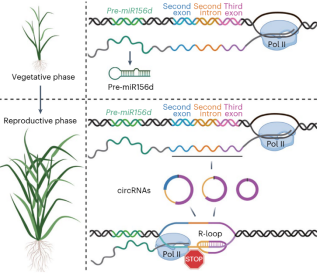
Flowering time (heading stage), one of rice's most important agronomic traits, not only determines the suitable cultivation regions and seasonal adaptability of rice varieties, but also critically influences yield, quality and stress resistance. The regulatory network controlling rice flowering is highly complex, integrating endogenous and exogenous signals through three major pathways: photoperiod, temperature, and age. By mediating the age of the plants, the molecular timer miR156 decreases progressively with plant aging, ultimately regulating the transition from vegetative to reproductive growth. However, the molecular mechanisms underlying the age-dependent expression pattern of miR156 remain unclear. The team has for the first time revealed a novel regulatory mechanism where circular RNAs derived from rice pri-miR156d (ciMIR156Ds) negatively regulate miR156 levels through R-loop formation with their template DNA. The study demonstrates that ciMIR156D levels increase with plant age while reducing pri-miR156d and miR156 levels, thereby initiating rice flowering. These ciMIR156Ds form R-loops with the MIR156D parental gene, which inhibit RNA polymerase II transcriptional elongation and consequently suppress pri-miR156d synthesis. These findings uncover a sophisticated regulatory mechanism through which circular RNAs precisely modulate the age pathway's molecular timer miR156, providing new theories for developing rice varieties with diversified heading stages.
The research was supported by funding from the Guangxi “Bagui Scholar” Program and the National Natural Science Foundation of China. In recent years, Professor Liu Yunfeng's team has focused on non-coding RNA regulation and plant molecular genetics, with a series of groundbreaking findings published in internationally renowned journals including PNAS, PLoS Biology, The Plant Cell, and Plant Physiology.

 Address: No.100,East Daxue Road,Xixiangtang District,Nanning, Guangxi,China
 Postal Code: 530004
 Tel: 86-771-3238863
 Email: gjc@gxu.edu.cn